

What is Venetian plaster?
Venetian plaster is a decorative wall and ceiling finish made from slaked lime putty mixed with fine marble dust. Applied by hand in multiple thin layers using a steel trowel, it is then burnished to create a smooth, polished surface that mimics the depth and lustre of natural marble or stone. Unlike paint or wallpaper, it is the final surface — no covering required. It is a premium, handcrafted finish used in both residential and commercial interiors.
If you keep coming across the term “Venetian plaster” in interior design magazines, on Instagram, or in conversations with architects and designers, this is the guide to bookmark. We’ll cover everything: what it’s made of, what the different finish types look like, where it works best, what it costs, and how it compares to microcement, limewash and standard paint. By the end, you’ll know exactly whether it’s the right choice for your project.
Last updated 12 November 2026.
In this guide
- What is Venetian plaster, and what is it made of?
- The main finish types are explained
- Where to use it — and where to avoid it
- How Venetian plastering is applied
- Pros and cons
- Venetian plaster vs microcement, limewash and paint
- How much does it cost?
- How to choose a Venetian plasterer
- Venetian plaster across Surrey, London and Buckinghamshire
- Frequently asked questions
What is Venetian plaster, and what is it made of?
Venetian plaster has been used in interiors since Roman times, refined and popularised in Venice during the Renaissance period, hence the name. What has made it endure for centuries is simple: the finish it produces is unlike anything else. No paint, wallpaper or modern coating fully replicates the depth, warmth and handcrafted character of a well-executed Venetian plaster wall.
What is Venetian plaster made of?
Traditional Venetian plaster is made from two primary ingredients:
- Slaked lime putty — calcium hydroxide produced by combining quicklime with water and leaving it to mature. This is the same base material used in traditional lime plastering and limewash for centuries. It is naturally breathable, antibacterial, and environmentally low-impact.
- Marble dust — finely ground particles of natural marble. These give the finish its characteristic depth, subtle translucency and the ability to take a high burnished polish. The finer the marble dust, the smoother and more reflective the final surface.
Natural pigments are added to the mixture to achieve colour. Critically, this means the colour runs through the entire body of the plaster, not just on the surface like paint. This is what gives Venetian plaster its tonal depth and richness: light enters slightly into the surface before reflecting, creating a three-dimensional quality that shifts subtly with changing light conditions throughout the day.
Modern specialist-grade Venetian plaster products refine this traditional recipe with carefully developed additives that improve workability, adhesion and durability, while retaining the same core lime and marble composition and the same handcrafted application process.
The main Venetian plaster finish types are explained.
Venetian plaster is not a single look, it is a family of related finishes. Understanding the different types helps you choose the right one for your space, your interior style, and your practical requirements.
Venetian plaster, polished plaster, marmorino and stucco veneziano compared
These four names describe closely related lime and marble dust plasters. The differences come down to marble dust content, how the surface is finished and the name used in the UK versus Italy.
| Name | What it is | Look and best use |
|---|---|---|
| Venetian plaster | Slaked lime putty and marble dust, hand-applied in thin coats and burnished | Polished to textured, with colour running through the plaster. Feature walls, living spaces, bedrooms, ceilings |
| Polished plaster | The broader UK term for any plaster burnished to a sheen. UK homeowners usually mean a Venetian-style lime and marble finish | Smooth, glassy, light-reflective. Feature walls, hallways, reception rooms |
| Marmorino | A refined variant with a higher marble dust content | Very smooth and stone-like, closer to honed than polished marble. High-end residential and boutique hospitality spaces |
| Stucco veneziano | The traditional Italian name for Venetian plaster. In the UK, “stucco” on its own usually means exterior render | Same as Venetian plaster |
None of the four is suitable for showers. Tadelakt is the lime option for wet areas. In short: if you are choosing between them, you are mostly choosing a sheen. For fully waterproof surfaces, see Venetian plaster vs microcement.
Polished marble plaster
The most recognisable Venetian plaster finish. Applied in multiple thin coats and burnished while still part-cured using firm, circular trowel pressure, the surface develops a deep, glassy sheen that genuinely resembles polished marble. A final wax coat is applied and buffed to protect and enhance the finish. Polished marble plaster is dramatic, light-reflective and luxurious, particularly effective on feature walls, in reception rooms, and in spaces with good natural light. It is the most labour-intensive Venetian finish and typically the highest investment. Our polished plaster page shows the full range.

Textured Venetian plaster
Where polished plaster is smooth and reflective, textured Venetian plaster deliberately retains visible grain, movement and tactile depth in the surface. Available in fine, medium or coarse grain depending on the product and application technique. Fine-grain textured plaster has a subtle, sophisticated quality, slightly rough to the touch but visually refined. Coarse-grain options create a bolder, more rustic or artisanal effect. Textured finishes are particularly well-suited to living rooms, hallways, and spaces where you want warmth and character rather than high-gloss drama. Browse more on our textured Venetian plaster page.

Marmorino
A more refined variation of polished plaster with a particularly high marble dust content, marmorino produces an exceptionally smooth, stone-like surface with a subtle luminosity. It differs from standard polished marble plaster in its finer, more consistent texture and the particular quality of light it reflects — closer to honed rather than polished marble. Marmorino is frequently specified in high-end residential projects and boutique hospitality spaces where a quietly luxurious, understated finish is required. It also takes pigment beautifully, allowing for very precise colour work.
Tadelakt
Originating in Morocco, tadelakt is a traditional lime plaster with a unique characteristic: when burnished and treated with olive oil soap, it becomes naturally water-resistant without requiring a chemical sealant. This makes it one of the few lime-based finishes genuinely suited to bathrooms, wet rooms and basin surrounds. The finish has an organic, slightly irregular quality, no two installations look identical, and a warmth that suits spa-style bathrooms, natural material interiors and heritage properties. Tadelakt requires considerable skill and experience to apply correctly, and the curing and soap-polishing process is time-sensitive. For bathrooms more generally, read why Venetian plaster suits a bathroom.
Concrete and industrial Venetian plaster
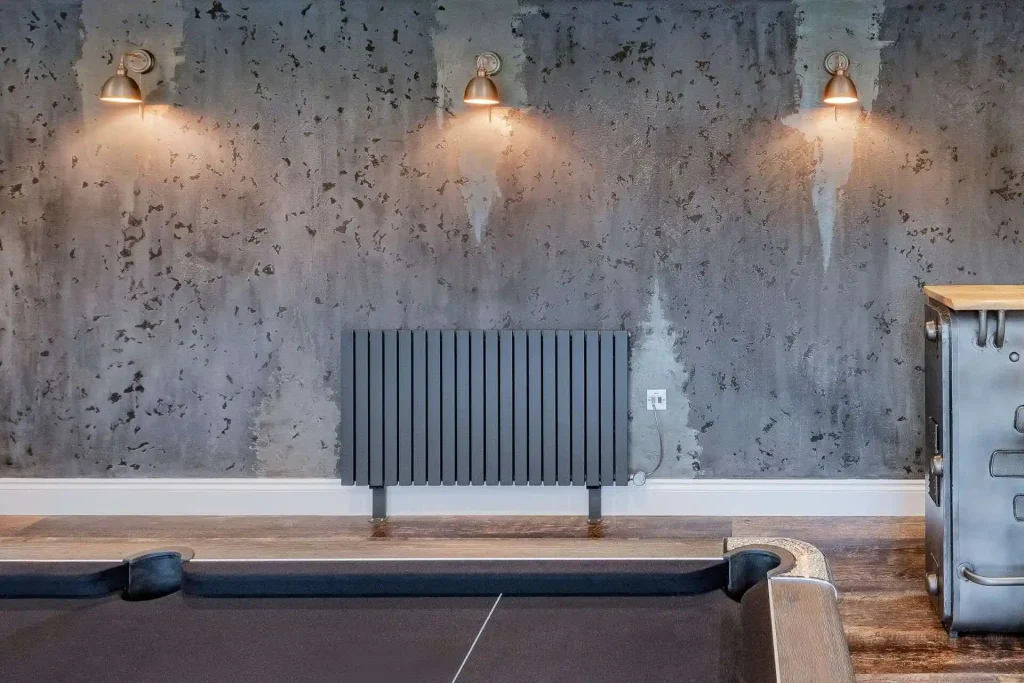
A family of finishes that draws on the aesthetic of raw concrete and polished industrial surfaces, but delivered through a Venetian plaster-based system rather than actual cement. The result is a matte, textured surface with trowel marks and tonal variation visible in the surface, warmer and more nuanced than real concrete, with the practical advantages of a lime-based finish. Works particularly well in contemporary open-plan spaces, media walls and commercial interiors where an urban industrial aesthetic is desired. See our concrete Venetian plaster finishes.
Metallic and hybrid finishes
Venetian plaster can be blended or layered with metallic pigments, copper, gold, silver, bronze, to create surface effects that catch and reflect light in a way that no paint can replicate. These are typically used as feature elements rather than whole-room treatments: a chimney breast, an alcove, a media wall panel. At Signature Walls, we also create hybrid installations that combine multiple finish types in a single wall, for example, a textured Venetian base with a metallic top coat and embedded stencil work, for truly bespoke, one-of-a-kind surfaces. For ideas, see our guide to metallic Venetian plaster.

Where to use Venetian plaster — and where to avoid it
Where it works best
- Living rooms and reception rooms — feature walls, chimney breasts and media walls are the most popular residential applications. A single Venetian plaster wall transforms a room without overwhelming it.
- Bedrooms — particularly headboard walls and behind-bed feature walls. The texture and warmth create a calm, luxurious backdrop that suits both contemporary and traditional schemes.
- Hallways and staircases — the first surfaces guests encounter, and an opportunity to make an immediate impression. A polished plaster hallway communicates quality throughout the rest of a home.
- Ceilings — less common but highly effective. A polished plaster ceiling reflects light beautifully and adds unexpected drama. Particularly powerful in double-height spaces or rooms with architectural lighting.
- Commercial spaces — restaurants, hotel lobbies, reception areas, boutique retail and office spaces. The premium, tactile quality of Venetian plaster communicates brand values in a way that painted walls simply cannot.
- Bathrooms (with the right finish) — traditional lime-based Venetian plaster is not suitable for wet areas, but Tadelakt is naturally water-resistant and designed specifically for bathroom walls and basin surrounds.

Where to avoid standard Venetian plaster
- Shower enclosures and wet rooms — direct sustained water contact will damage lime-based Venetian plaster. Use Tadelakt or microcement in these areas instead.
- Kitchen splashbacks — steam, grease and cleaning products are not compatible with traditional Venetian plaster. Microcement is the recommended alternative for kitchen walls.
- Floors — Venetian plaster is applied in thin decorative coats and is not designed to withstand foot traffic. Microcement is the correct choice for seamless decorative floors.
- High-impact areas — walls that regularly receive knocks, scrapes or hard contact (busy hallways where furniture is moved, garages, utility rooms) are better served by more impact-resistant finishes.
How Venetian plastering is applied
Application is a multi-stage, entirely handcrafted process that cannot be rushed. The quality of the finished surface is determined as much by the preparation and technique as by the materials themselves.
- Surface preparation — the substrate must be structurally sound, clean, dry and primed correctly. Any imperfections — cracks, uneven areas, previous coatings that aren’t fully adhered, must be addressed before work begins. A poor substrate produces a poor finish, regardless of the skill of the applicator.
- Base coat application — the first layer of plaster is applied with a steel trowel in thin, overlapping passes. This establishes adhesion and begins to build the foundation for the layers above.
- Build-up coats — typically two to three further coats, each applied in different directions to build depth, eliminate trowel lines, and develop the characteristic tonal variation of the finish.
- Burnishing — while the final coat is still slightly green (part-cured but not fully dry), the surface is burnished using firm, circular pressure with a clean, flat steel trowel. This compresses the lime particles and marble dust, closing the surface and producing the polish and sheen. The timing of this stage is critical, too early or too late, and the desired result cannot be achieved.
- Waxing and sealing — a protective wax or specialist sealer is applied to the completed surface, deepening the colour and providing protection against everyday contact. For polished finishes, this is buffed to the final sheen level.

A feature wall typically takes two to four days from start to finish. Larger installations or intricate designs requiring multiple colours, stencil work or metallic elements will take longer. The layering and curing process cannot be accelerated, which is part of why the result is so distinctly different from anything that can be applied in a single visit.
Venetian plaster pros and cons
| Advantages | Limitations |
|---|---|
| Unique depth and light quality no paint can replicate | Higher investment than paint or wallpaper |
| Made from natural materials — low VOC, breathable, antibacterial | Requires specialist installation — not DIY-friendly |
| Exceptionally durable — 20+ year lifespan when maintained | Not suitable for wet areas (except Tadelakt) |
| Each installation is unique — no two walls alike | Can be marked by sustained physical contact |
| Adds appeal to a property | Colour changes require new coats, not just repainting |
| Wide range of finish types, colours and textures | Not suitable for floors or high-traffic horizontal surfaces |
| Regulates indoor humidity — absorbs and releases moisture | Repairs, while possible, require a skilled specialist to match |
Venetian plaster vs other finishes
The most common question after “what is it?” is “how does it compare to what I already know?” Here is an honest comparison of Venetian plaster against the finishes it is most often considered alongside.
Venetian plaster vs microcement
These two finishes are frequently confused because they can look similar, both are hand-applied in thin layers, both produce a seamless surface with tonal depth, and both are used in high-end residential and commercial interiors. The differences come down to composition, application and where each one is best used.
| Venetian plaster | Microcement | |
|---|---|---|
| Made from | Slaked lime + marble dust | Cement + polymer resin + fine aggregate |
| Aesthetic | Warm, marble-like, can achieve mirror polish | Industrial, concrete-like, matte to satin sheen |
| Suitable for floors | No | Yes |
| Wet areas / showers | No (Tadelakt only) | Yes — fully waterproof when sealed |
| Over existing tiles | Not typically | Yes — if tiles are fully bonded |
| Breathability | High — lime-based, naturally breathable | Lower — sealed finish |
| Eco credentials | Excellent — natural materials, zero VOC | Good — improving, some VOC-free options |
| Best suited to | Feature walls, living spaces, bedrooms, and ceilings | Bathrooms, floors, kitchens, wet rooms |
In short: if you want a warm, luminous, marble-like wall finish in a dry living space, Venetian plaster is the natural choice. If you need a seamless finish that is fully waterproof, suitable for floors, or needs to go over existing tiles, microcement is the right material. Many of our projects use both Venetian plaster in the living areas, microcement in the bathrooms and kitchen. Read our full microcement guide →
Venetian plaster vs limewash
Limewash is made from slaked lime and water, applied as a thin, translucent wash that soaks into porous surfaces rather than building up on top of them. It produces a soft, cloudy, faded effect, think aged Italian plasterwork or the chalky, textured walls seen across Scandinavian and Mediterranean interiors. It has had a significant resurgence in popularity recently, partly driven by the Japandi and Wabi-sabi interior trends.
| Venetian plaster | Limewash | |
|---|---|---|
| Finish quality | Polished, glossy to textured | Matte, chalky, deliberately imperfect |
| Investment level | Premium — specialist installation required | Lower — more accessible, DIY possible |
| Durability | 20+ years with care | Requires touch-ups every 5–7 years |
| Depth and character | Very high — multi-layer, burnished | Moderate — intentionally aged aesthetic |
| Interior style | Luxury, contemporary, traditional, high-end | Rustic, Scandi, Japandi, heritage, natural |
| Eco credentials | Excellent | Excellent — among the most natural finishes available |
Limewash and Venetian plaster are not direct competitors — they suit different aesthetics and budgets. Limewash is the right choice for a natural, aged, understated wall with eco credentials at a lower price point. Venetian plaster is the right choice when you want a finish that is genuinely premium, long-lasting, and visually distinctive.
Venetian plaster vs standard paint and wallpaper
The comparison here is less about “which is better” and more about understanding what paint and wallpaper cannot do, and why some homeowners choose to invest more:
- Depth — paint sits flat on a surface. Venetian plaster has dimensional depth that changes with the light. This cannot be replicated by any paint finish, regardless of price.
- Uniqueness — every Venetian plaster wall is slightly different. Paint produces identical results across any wall in any house.
- Longevity — a well-maintained Venetian plaster installation outlasts multiple paint cycles. The upfront investment is higher; the long-term cost per year is often comparable.
- Sustainability — lime-based Venetian plaster is a natural material with zero VOCs and positive indoor air quality effects. Most paints, even premium ones, contain VOCs and synthetic binders.
- Statement value — Venetian plaster is a design feature in its own right. Paint is a backdrop. This is not a criticism of paint; it is simply a different role. For more, see Venetian plaster feature walls vs paint, wallpaper and panels and our answer on whether Venetian plaster can be painted over.
Venetian plaster vs stucco
In the UK, stucco traditionally refers to an exterior lime-based render used on the facades of Georgian and Victorian buildings. In the US and in some European contexts, “stucco” is used more broadly to describe lime-based interior plaster finishes, which is where confusion with Venetian plaster arises. Venetian plaster and traditional Italian stucco share the same core materials (lime putty and marble dust) and are part of the same family of decorative lime plaster finishes. In practice, when someone in the UK asks about “stucco walls” in an interior context, they are usually describing a Venetian or polished plaster finish. Our full explainer covers how Venetian plaster and stucco differ.
How much does Venetian plaster cost in the UK?
Venetian plaster is a premium finish and priced accordingly; it reflects specialist materials, multi-day skilled application, and a handcrafted result that genuinely cannot be achieved any other way.
- Feature walls — typically £2,500–£3,500 + VAT depending on size, finish type and complexity
- Full rooms — larger projects covering multiple walls or ceilings will be quoted individually based on total area and finish specification.
- Commercial installations — priced individually; typically involve larger areas and a faster timescale.
The investment covers materials, specialist preparation, the multi-coat application process, burnishing, waxing and sealing, and aftercare documentation. For a full breakdown with real-world examples, see our Venetian plaster cost guide.
If you would like to see how these finishes look and feel at full wall scale, visit our Venetian plaster showroom in Amersham, or read more about Venetian plaster installation in Amersham.
How to choose a Venetian plasterer
Because the finish depends so heavily on skilled application, the installer matters as much as the material. When comparing Venetian plasterers, ask to see completed walls in person, ask which products they use and how many coats they apply, and request a written specification before work begins. These two guides cover the questions in more detail: what to ask a Venetian plaster specialist before you commit and how to choose a Venetian plaster specialist.
Venetian plaster across Surrey, London and Buckinghamshire
Signature Walls installs Venetian plaster in homes and commercial interiors across Surrey, London and Buckinghamshire. Start with our Venetian plaster service page, or explore the regional pages for Buckinghamshire, Surrey and London. We also cover Kingston upon Thames as part of our Surrey and south-west London service area. To see real installations, browse our project gallery, and to discuss your own project, get in touch for an initial estimate.
Frequently asked questions
What is the difference between Venetian plaster and normal plaster?
Standard plaster, gypsum or sand/cement render is a structural base coat applied to walls before decorating. It is never intended to be seen and is always painted or wallpapered over. Venetian plaster is a decorative finish applied over a prepared substrate. It is the final surface and requires no covering. The two materials serve entirely different purposes and are not interchangeable. We explain more in the difference between plaster and Venetian plaster.
What is Venetian plaster made of?
Traditional Venetian plaster is made from slaked lime putty (calcium hydroxide) mixed with finely ground marble dust, with natural pigments added to achieve colour. The colour runs through the full body of the plaster rather than sitting on the surface like paint, which is what gives the finish its characteristic depth and tonal variation.
Is Venetian plaster the same as polished plaster?
In UK usage, the terms are largely interchangeable. Polished plaster is the broader category, any plaster finish that is burnished to a sheen. Venetian plaster refers specifically to the lime and marble dust formulation. When a UK homeowner or interior designer asks for polished plaster, they almost always mean a Venetian-style lime and marble finish.
Is Venetian plaster waterproof?
Traditional lime-based Venetian plaster is not waterproof and should not be used in shower enclosures or in areas of direct sustained water contact. Tadelakt, a Moroccan lime plaster from the same family, is naturally water-resistant when burnished and treated with olive oil soap, and is suitable for bathroom walls and basins. Microcement is the recommended choice for fully waterproof seamless installations in wet rooms, showers and floors. See our microcement bathroom page.
How long does Venetian plaster last?
When professionally applied and properly maintained, Venetian plaster is exceptionally durable; installations lasting twenty years or more are common. The material itself is inherently stable; deterioration is almost always caused by physical damage or moisture ingress in areas where the finish is not suited to wet conditions. Read how long Venetian plaster lasts and how to protect your finish for aftercare.
Can Venetian plaster be repaired if it gets damaged?
Yes, localised damage can be repaired by a specialist. The visibility of any repair depends on the finish type, colour and age of the original installation. Textured finishes are generally more forgiving than high-gloss polished plaster. We always recommend documenting the specification of an installation so repairs can be colour-matched accurately. See what causes Venetian plaster damage for the usual culprits.
Can you paint over Venetian plaster?
Technically yes, but painting over a polished or textured Venetian plaster wall hides the depth, sheen and colour variation that make the finish distinctive, and it is very difficult to reverse. If you simply want a different colour, ask a specialist whether re-coating is an option. Our full answer is in can Venetian plaster be painted over.
What interior styles does Venetian plaster suit?
Venetian plaster is genuinely versatile across interior styles. Polished marble plaster suits luxurious contemporary and classic traditional schemes. Textured and concrete-effect Venetian finishes work beautifully in industrial, Japandi, Wabi-sabi and minimalist interiors. Marmorino is frequently used in high-end Scandinavian-influenced spaces. The breadth of available colours, textures and finishes means there is a Venetian plaster option for almost any design direction. Our guide to the interior styles Venetian plaster suits goes further.
Can I apply Venetian plaster myself?
DIY application is possible, but it rarely produces results that match a professionally installed finish. The burnishing stage in particular requires developed feel and timing to execute correctly, and errors made at the build-up coat stage are very difficult to correct once cured. Given the cost of specialist materials, most homeowners find it worth engaging a trained installer to protect the investment. Our guide on how to choose a Venetian plaster specialist covers what to look for.
Does Venetian plaster add value to a home?
A well-executed Venetian plaster installation is widely regarded as a premium feature that enhances a property’s appeal, particularly in the mid-to-high end residential market where buyers understand and value handcrafted finishes. That said, it is a personal choice; some future buyers will love it, and some may want to change it. If resale is your primary motivation, a feature wall in a classically styled neutral colour is the most universally appealing choice. See whether Venetian plaster adds value to a property.
What is Marmorino plaster?
Marmorino is a refined variant of Venetian polished plaster with a higher marble dust content, producing an exceptionally smooth, stone-like surface. It is considered one of the most sophisticated finishes within the Venetian plaster family, subtler and more luminous than standard polished plaster, often described as resembling honed rather than polished marble. It is a specialist finish that requires a high level of application skill.
What is Tadelakt?
Tadelakt is a traditional Moroccan lime plaster that becomes naturally water-resistant when burnished and polished with olive oil soap during the curing process. It produces an organic, slightly irregular surface with a smooth, silky feel. Unlike other lime-based Venetian plasters, Tadelakt is genuinely suitable for bathroom walls, shower surrounds and basins. It is one of the most demanding finishes to apply correctly, and should only be attempted by specialists with specific Tadelakt experience.

Ready to see Venetian plaster in person?
Photographs don’t fully capture the depth and light quality of these finishes. Visit our showroom in Amersham to explore the full range of Venetian plaster textures, colours and finishes, with expert guidance from the team.
Book a showroom visit.Written by Peter Salter, Founder of Signature Walls, specialist installer of Venetian plaster, microcement and decorative finishes across Surrey, Kingston upon Thames, London, Amersham and the Home Counties.
Keep Exploring Venetian Plaster
Ready to plan a wall? Speak to our feature wall specialists, browse 24 feature wall ideas for 2026, compare plaster textures or review our full surface and finish options. Photographs never show how Venetian plaster behaves in real light, so visit our Amersham showroom at Sky House Design Centre, by appointment, or get in touch for an initial estimate. We also work across Surrey and London. Thinking of a wet room? Read why Venetian plaster suits bathrooms.
