
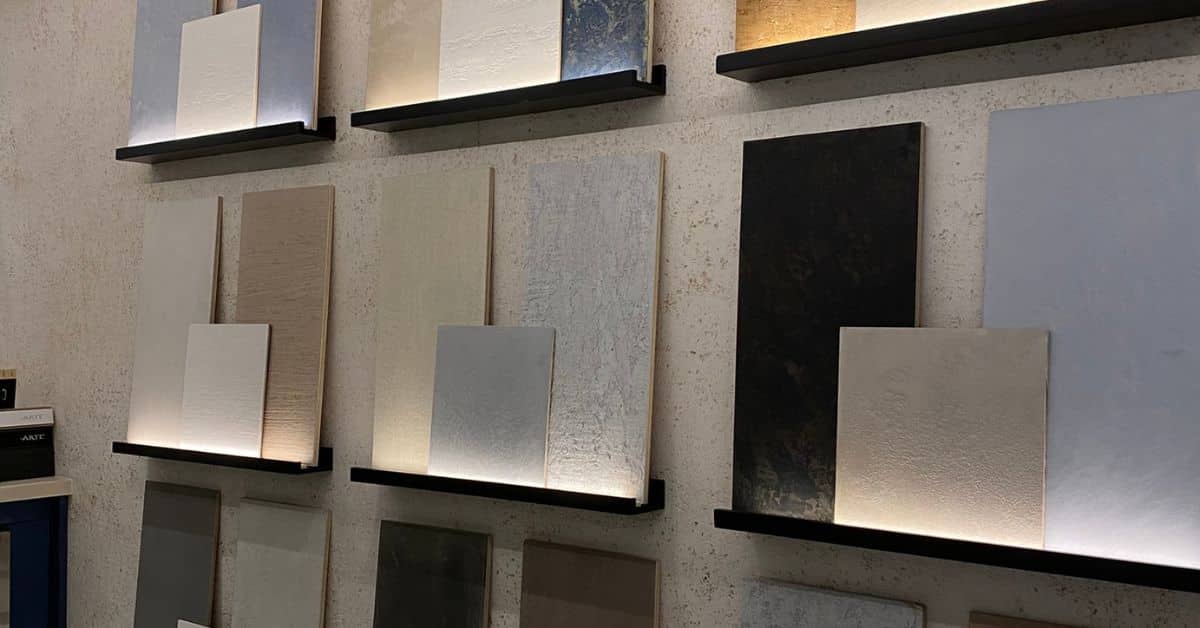
Most people researching Venetian plaster or microcement start the same way: scrolling through Pinterest boards, saving Instagram posts, maybe downloading a few images to show their interior designer. It’s a reasonable approach, but it has a significant limitation.
Photographs flatten everything. They can’t show you how a polished plaster surface catches afternoon light differently from morning light. They can’t convey the subtle texture of a hand-applied limewash or the cool, almost stone-like feel of a well-executed microcement. They give you an idea, but ideas and reality don’t always match.
This is why showrooms exist. Not as a sales exercise, but as a practical solution to a genuine problem: how do you choose a wall finish you’ll live with for years when you’ve never actually seen it?
If you’re considering visiting a decorative Venetian plaster showroom, whether ours in Amersham or another, here’s what to expect and how to make the most of it.
Why Photographs Aren’t Enough (Even Good Ones)
Decorative plasters are three-dimensional finishes. They have depth, movement, and texture that change depending on where you’re standing and how the light hits them. A photograph captures one moment, one angle, one lighting condition.
Consider polished Venetian plaster. In a photograph, it might look like a flat, coloured wall. In person, you’ll notice the subtle variations where the plasterer’s trowel has compressed the material differently, creating areas that catch light while others absorb it. The result is a surface that feels alive, but only when you’re standing in front of it.
The same applies to microcement. Photos often make it look uniformly smooth, but in reality, the finish has character. Depending on the application technique, it might have gentle undulations, subtle tonal variation, or a deliberately industrial rawness. These aren’t flaws, they’re features. But you won’t know if you like them until you’ve seen them.
Then there’s colour. Screen calibration, photography lighting, and the colour temperature of your own device all affect how a finish appears in photos. A warm, creamy Venetian plaster can look stark white on one screen and yellow on another. In a showroom, you see the actual colour in real light, no interpretation required.
What a Good Showroom Should Offer
Not all showrooms are equal. Some are token efforts, a few sample boards propped against a wall. Others are genuine working spaces where you can see finishes applied at scale, in realistic conditions.
Here’s what to look for:
Full-scale applications, not just samples
A 30cm sample board gives you a hint of a finish, but it can’t show you how that finish will look covering an entire wall. The best showrooms feature full-scale panels or even complete room installations, so you can assess how a finish works as part of a space rather than in isolation.
Multiple finishes side by side
Seeing a single finish tells you what it looks like. Seeing multiple finishes together helps you understand the differences between them. Polished plaster versus matte limewash. Warm-toned Venetian plaster versus cool concrete-effect microcement. Light-reflecting metallics versus soft, chalky textures.
Comparison is how you develop preferences. A good showroom facilitates that.
Natural and artificial lighting
Decorative finishes behave differently under different light sources. A showroom should let you see how finishes appear in natural daylight as well as under artificial lighting. Some high-gloss polished plasters look spectacular in bright sunlight but can feel stark under downlights. Others come alive in the evening. Understanding this before you commit saves disappointment later.
Knowledgeable staff who can answer technical questions
A showroom isn’t just about looking, it’s about learning. You should be able to ask questions about application processes, material properties, maintenance requirements, and suitability for different rooms. If the people staffing the showroom can’t answer these questions confidently, that tells you something about the company’s depth of expertise.
How to Prepare for Your Visit
You’ll get more from a showroom visit if you arrive with some preparation. Not extensive research, just enough context to make the conversation productive.
Bring reference images
If you’ve saved photos of finishes you like, bring them. They give the showroom team a starting point for understanding your aesthetic preferences. Even if the exact finish in your photo isn’t available, they can point you toward similar options.
Know your room conditions
Think about where you’re planning to use the finish. Is it a bathroom with high humidity? A south-facing living room with strong sunlight? A basement conversion with limited natural light? These factors affect which finishes are suitable and how they’ll perform over time.
Have a rough sense of your budget
Decorative plasters span a wide price range. A simple limewash feature wall is a different investment from a full microcement bathroom. Knowing your approximate budget helps the showroom team guide you toward realistic options rather than showing you finishes that aren’t viable for your project.
Bring anyone involved in the decision
If you’re working with an interior designer, architect, or partner who has opinions about the finish, bring them along. Collective decisions made in person tend to stick better than those made by committee over WhatsApp photos.
What Happens During a Typical Visit
Every showroom operates slightly differently, but here’s a general sense of what to expect.
You’ll usually start with a conversation about your project. What rooms are you considering? What style are you drawn to? Have you seen finishes elsewhere that you liked? This helps the showroom team understand what to show you first.
Then you’ll move through the space, looking at different finishes. A good host will explain what you’re seeing, the materials used, the application technique, and how the finish would behave in different environments. They’ll encourage you to touch surfaces (it matters) and look at them from different angles.
If you’re seriously considering a particular finish, you might discuss colour options. Many decorative plasters can be tinted to a wide range of colours, so the showroom finish is often a starting point rather than your only option.
Toward the end, if you’re interested in moving forward, you might discuss next steps: a site visit to assess your walls, a detailed quote, or simply more time to think. There shouldn’t be any pressure to decide on the spot. A showroom visit is part of your research process, not a sales funnel.
Questions Worth Asking While You’re There
Use the opportunity to gather information you can’t get from a website:
“How does this finish age over time?” Some plasters develop a patina. Others stay exactly as applied. Understanding the long-term behaviour helps you choose something you’ll still love in ten years.
“What maintenance does this require?” Most decorative finishes are low-maintenance, but some require periodic sealing or specific cleaning approaches. Know before you commit.
“Can this be repaired if it’s damaged?” Accidents happen. Knowing whether a finish can be spot-repaired or requires larger interventions affects your peace of mind.
“What’s the typical lead time for a project like mine?” Skilled specialists are often booked weeks or months ahead. Understanding scheduling helps you plan your wider renovation timeline.
“Can you show me this finish in a colour closer to what I’m considering?” If the showroom has sample boards or can point you to completed projects in similar tones, you’ll get a better sense of your specific vision.
The Real Value of Seeing Before You Decide
Decorative wall finishes are significant investments, not just financially, but visually. They define how a room feels. They’re the backdrop to your daily life. And unlike paint, they’re not easily changed if you get it wrong.
A Venetian plaster showroom visit reduces risk. It replaces guesswork with certainty. It lets you make a decision based on what you’ve actually seen and touched, rather than what you’ve imagined from a photograph.
More than that, it changes the dynamic with whoever you hire. When you can describe exactly what you want because you’ve stood in front of it, the conversation becomes clearer. Expectations align. The finished result matches the vision you had, because the vision was grounded in reality from the start.
Visiting the Signature Walls Showroom in Amersham
If you’re in Buckinghamshire, Surrey, or London and considering decorative plaster for your home, we’d be glad to welcome you to our showroom at Sky House Design Centre in Amersham.
You’ll find working examples of Venetian plaster, polished plaster, limewash, microcement, metallic finishes, and concrete effects, all applied at scale so you can see exactly what you’d be getting. Our team can walk you through the options, answer technical questions, and help you narrow down what’s right for your space.
No hard sell, no pressure. Just an opportunity to see beautiful finishes up close and have a proper conversation about your project.
Schedule a showroom visit or call us on 0203 488 7578 to arrange a time.
Signature Walls Showroom
Sky House Design Centre
Raans Road
Amersham
HP6 6FT
Open by appointment, we recommend booking ahead so we can give you our full attention.
