

Quick answer: Venetian plaster can be applied to new plasterboard (drywall) and to existing smooth, stable surfaces. Uneven or damaged walls, porous surfaces, concrete and wood need extra preparation first, while flexible surfaces and areas with high moisture are not suitable.
Suppose you’re considering having a Venetian plaster installation in your home, either as a standalone feature wall or as part of a more comprehensive project. In that case, it’s worth getting the foundational parts right.
Given the higher investment for this wall covering over a regular plastered and painted finish, you’ll no doubt want to protect the investment as best you can and give your installer the best place to start.
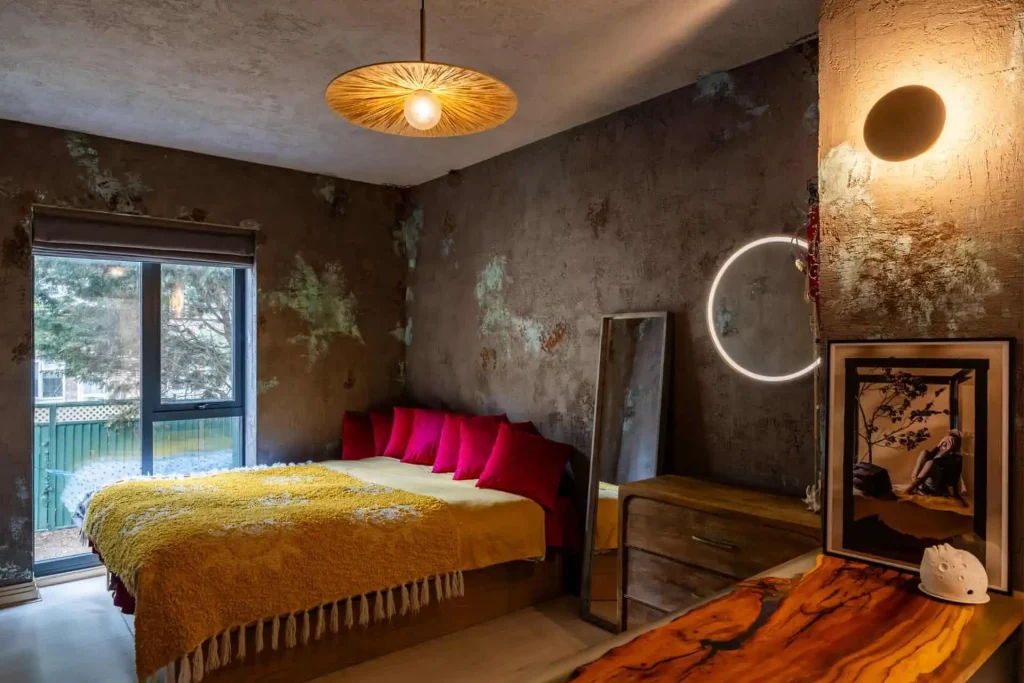
It’s worth noting that the choice of product and finish will dictate which substrate is most suitable and the level of preparation involved.
Here’s a rundown of suitable and less suitable substrates for Venetian plaster in typical UK homes:
Ideal Wall Substrates To Install Venetian Plaster On
New Gypsum Plasterboard (Drywall)
Most builders preferred over-boarding existing walls or creating new internal stud work. It provides a good base, which may be used independently or coated in pink gypsum plaster to give a smooth, even surface. This is the ideal base to achieve a perfect polished Venetian plaster wall. Any defects can come through in the thinly layered decorative top coating, so flawless preparation is essential.
Ensure all joins or seams are correctly filled, and any minor imperfections are sanded to a reasonable level.
Existing Smooth and Stable Surfaces
Previously painted walls can also provide an ideal substrate, provided they’re sound and prepared correctly. This will involve scraping any loose or flaky paint filling and sanding where needed to achieve a good finish.
Substrates Requiring Additional Preparation Before Venetian Plaster Installation
Uneven or Damaged Surfaces
These will need levelling and possible reinforcement before applying Venetian plaster. Techniques like skimming with a thin layer of basecoat plaster are standard practice here, any repair works will be approached on a case-by-case basis. You cannot install over blown plaster.
Porous Surfaces
Some substrates may require additional sealing to prevent the plaster from drying too quickly, affecting its finish and giving a consistent suction level.
Concrete
Depending on the smoothness and condition, they may be suitable but often require an additional layer of basecoat to provide before the usual layers from there to achieve your desired finish.
Wood
We have some products that can be installed over wood, such as ply or MDF; not every product can be, so we’ll need to consider that when choosing a finish.
Unsuitable Substrates For Venetian Plaster
Flexible Surfaces
Substrates prone to cracking or movement (e.g., some wood panelling) are poor candidates for Venetian plaster, which can also crack under stress.
Areas with High Moisture
Bathrooms and kitchens may be possible with the proper moisture barrier, skilled application, and additional sealant. However, we wouldn’t recommend installing Venetian plaster in wet areas such as shower enclosures or around the bath. The risk of moisture-related issues increases, and the product will fail. We have much better solutions for these areas, such as microcement.
Additional Considerations When Installing Venetian Plaster On Walls
Building Age: Older UK homes may have mixed interior wall materials with differing levels of stability and porosity. We do have breathable products suitable to be installed in older properties, including listed properties that can be notoriously tricky to work with.
Damp Issues: Venetian plaster is not a solution for damp problems; it will keep the issue underneath, which can ruin the overall product once applied to Walsall.
Before any Venetian plaster work begins, you’ll need to address underlying problems and ensure substrates are fully dry; we’ll test moisture levels ourselves to ensure the surface is suitable before installing your Venetian plaster.
Application Skill: Venetian plaster application requires a high level of skill,l so we wouldn’t recommend adopting a D.I.Y approach or letting the normal plasterer or builder have a go because they watched a few videos on YouTube; you could end up with an expensive mess on your hands.
Each artist or applicator will have their own style, so it’s worth investigating some of their past works to see if that aligns with your vision for what you’re trying to achieve.
It’s always best to chat with a specialist, such as ourselves, to assess your surface requirements and recommend the most appropriate way to achieve your desired result.
The easiest way to do this is to email images to [email protected] or WhatsApp 07719 868 353
Visit the showroom
See Venetian plaster, polished plaster and microcement samples in person at our Amersham showroom, Sky House Design Centre, Raans Road, Amersham HP6 6FT. Our team can talk you through finishes, colours and next steps for your own space.
The showroom is open by appointment only: Monday to Thursday 9:00 to 17:00, Friday 9:00 to 15:00.
Book a showroom visit Or call 0203 488 7578.
Where to go next
To see how this looks in a real home, explore our Venetian plaster service or browse the full range of plaster finishes and options.
Budget matters, so our Venetian plaster investment guide sets out what shapes the figure, and you may also like how to protect your polished plaster finish. The next step is simple: get in touch for an initial estimate or see samples at our Amersham showroom, by appointment.
We install across London, Surrey and Buckinghamshire.
